Damp proofing · Lincolnshire

Damp proofing across Lincolnshire

We find out what’s really causing the damp, treat the cause, and finish the wall properly, ready to decorate. Free survey, written recommendations, 10-year guarantee and no pressure.

5-star on Google · 10-year guarantee · Fully insured

Or call 07400 219011

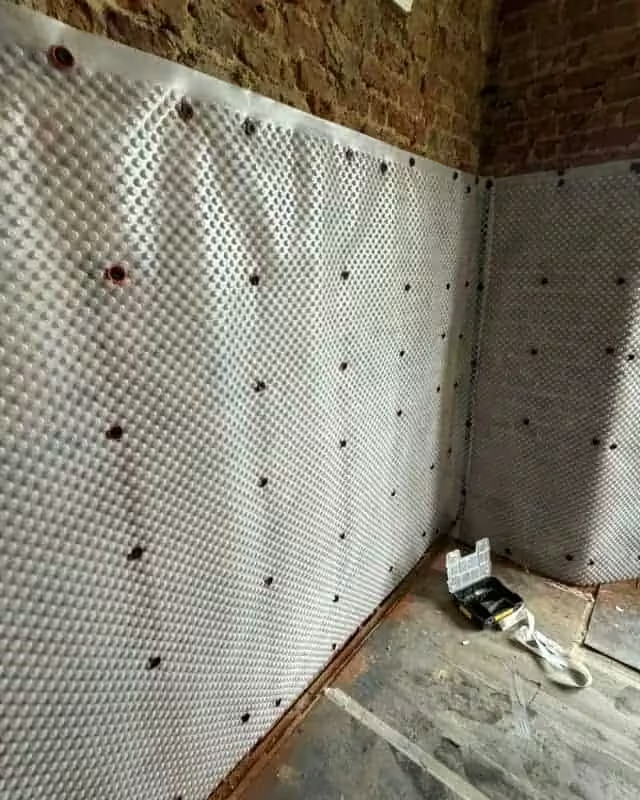
Cavity drain membrane being installed

Free quote

Book a free damp survey

Send a few photos on WhatsApp, or ask us to visit. We’ll look at the wall, take moisture readings where they’re useful, and give you a clear written recommendation and quote — with no obligation.

Full system spec sheets available on request, with a free technical analysis of your walls.

10-year guarantee · Fully insured · No obligation, no pressure

Add more detail (optional)

Fields marked * are needed so we can get back to you.

Prefer to talk? Call 07400 219011 or send photos on WhatsApp. You can also email contact@lincsrendersystems.com.

Damp proofing, done properly

We carry out damp surveys, treatment and replastering for homes across North Lincolnshire, North East Lincolnshire and nearby towns, including Lincoln. The important part is getting the diagnosis right, so we treat the cause — not just the stain.

Typical work includes taking failed or salt-damaged plaster back, treating the wall where it’s appropriate, and finishing with a salt-resistant, renovating or lime-based plaster, ready to dry and decorate. We’ll not sell a treatment that will not help.

Every damp-proofing job comes with guaranteed workmanship and a 10-year guarantee on damp proofing works, set out in writing, plus our Job Completion & Aftercare Pack. We’re a local team with 30+ years’ combined experience, fully insured, and quotes are free.

How the free survey works  ·  The systems we can use  ·  What happens, start to finish

Types of damp

Four common types, and the signs of each

They can look alike on a painted wall. The treatment is not the same, so it pays to tell them apart.

From the ground

Rising damp

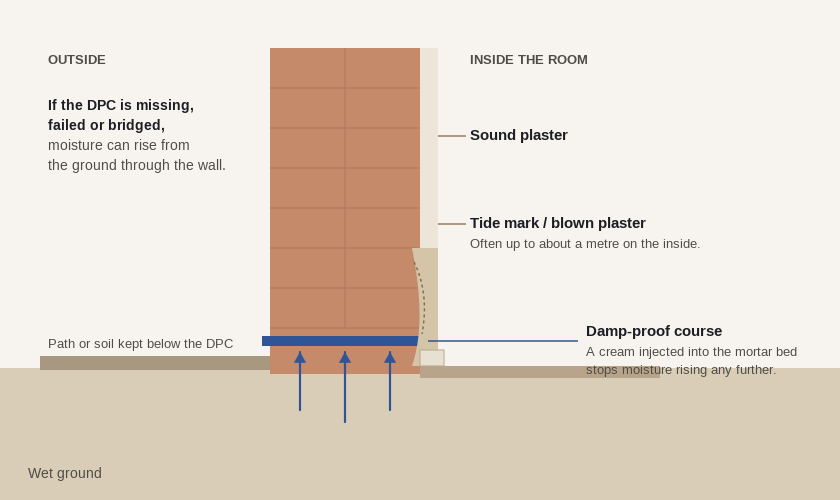
Moisture drawn up from the ground through the masonry, usually where a damp-proof course is missing, has failed, or has been bridged.

  • A tide mark on a ground-floor wall, often up to about a metre
  • White salt crystals, bubbling paint or blown plaster
  • Skirting boards or floors that are decaying at the base
  • A musty smell at low level, and a wall that feels damp to the touch

From a defect

Penetrating damp

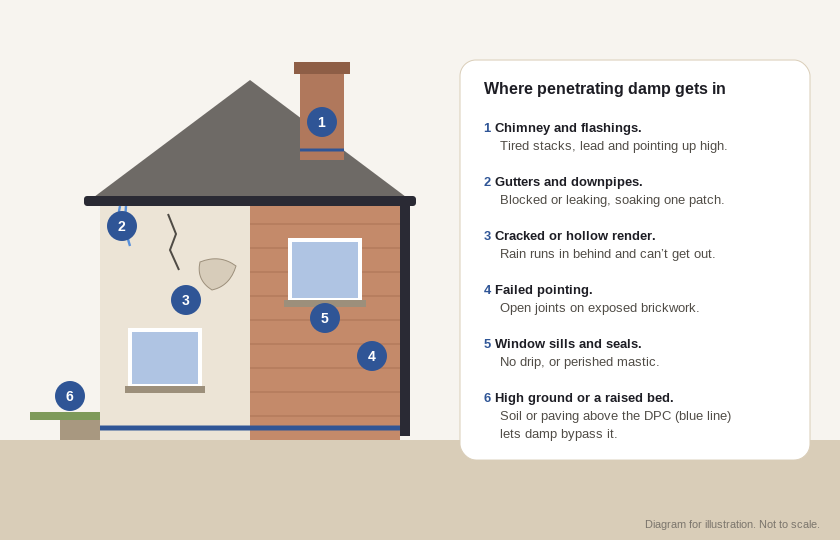
Rain or leak water getting in from outside — through cracked render, failed pointing, blocked gutters, a roof or window, or a failed seal.

  • A wet or stained patch at any height, not only at the base
  • Often worse after rain, and localised rather than a level line
  • Staining under a gutter, around a window or behind damaged render
  • Green growth or persistently wet masonry on the outside

From the air

Condensation

Warm, moist air hitting a cold surface. Very common in bedrooms, bathrooms and corners with little airflow. It is not a DPC problem.

  • Black mould on cold corners, ceilings or around windows
  • Misting on glass, and walls that feel cold and clammy
  • Worse in winter, or in rooms that stay closed up
  • Often no tide mark, and the lower wall may be dry

From high ground

Lateral damp and bridging

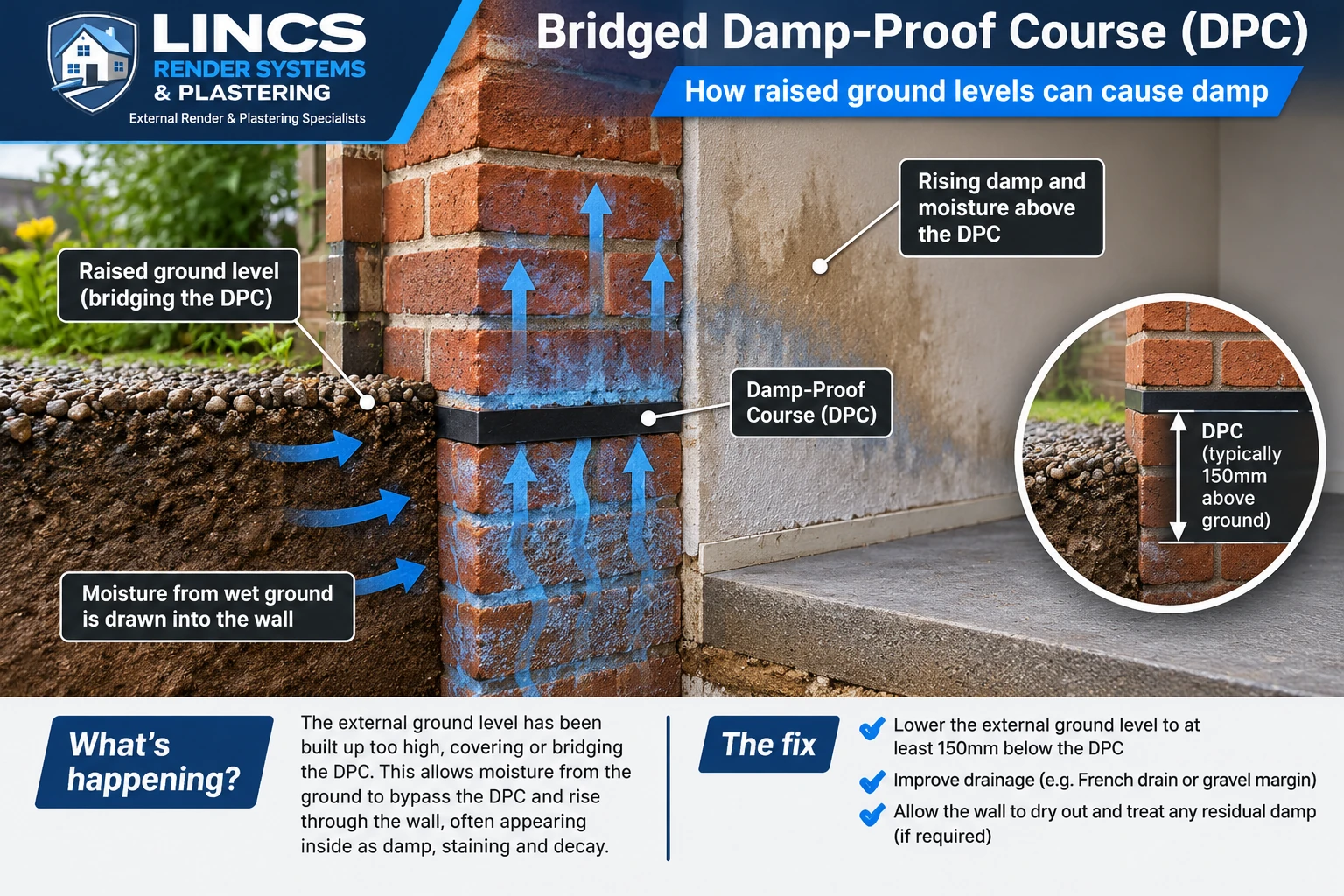
Moisture moving sideways from high ground, a retaining wall or an adjoining structure — or a perfectly good DPC that has been bridged by a raised path, step or flower bed.

  • Damp just above an external path, soil or paving that sits too high
  • Staining on a wall that holds back earth, or beside a raised drive
  • Debris, render or a floor screed covering the DPC line
  • The wall may dry if the bridge is removed, without a new injection
Diagram of a solid wall in cross-section: moisture rising from wet ground is stopped by a damp-proof course in the mortar, with a tide mark and blown plaster shown on the inside.
How rising damp travels through a wall, and where a damp-proof course sits. Diagram for illustration.
Failed plaster around a doorway in a North Killingholme room, before our damp-related repairs started.
From one of our own damp jobs: failed plaster around a doorway, before work started. Blown, crumbling plaster low on the wall is often the first thing people notice.
Diagram of a house showing six common ways rain gets into a wall: chimney and flashings, gutters and downpipes, cracked or hollow render, failed pointing, window sills and seals, and ground or a raised bed sitting above the damp-proof course.
Six common ways water gets in from outside. Diagram for illustration.

Damp higher up the wall is rarely rising damp

Rising damp stays low on ground-floor walls. A patch halfway up a wall, on a chimney breast, around a window or upstairs is far more likely to be water getting in from outside, or condensation.

That’s why we look at the outside of the wall too: the gutters, the render, the pointing, the sills and the ground levels. Fixing the way in is often the main job, and the inside can then be repaired once the wall has dried.

Condensation and mould

The most common damp of all, and no injection will fix it

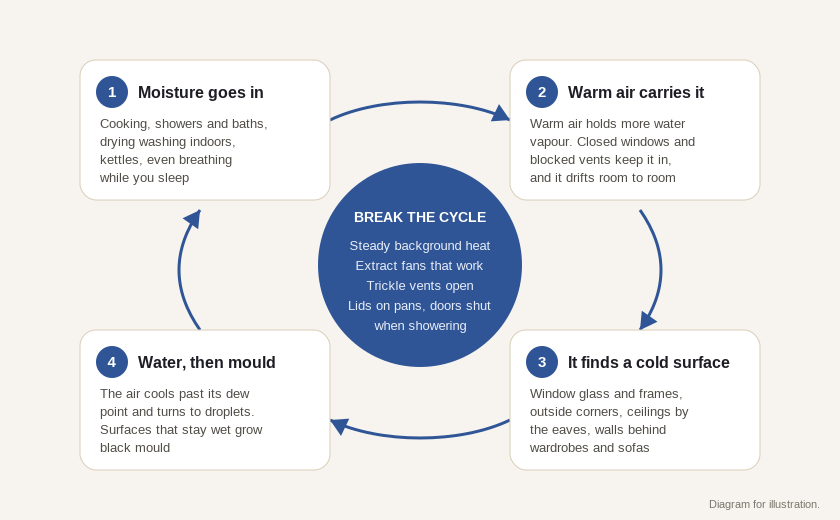
A normal household puts a surprising amount of moisture into the air every day: cooking, showers, kettles, drying washing indoors, even breathing while you sleep. When that warm, moist air meets a cold surface it turns back into water. Black mould follows wherever surfaces stay wet.

It tends to show up:

  • on window glass, frames and sills, first thing in the morning
  • in the top corners of outside walls, and on ceilings near the eaves
  • behind wardrobes, beds and sofas pushed against outside walls
  • in bathrooms, kitchens and bedrooms that stay closed up

We’ll never sell a damp-proof course for condensation. If that’s what we find, we’ll explain it and talk you through heating and ventilation. We don’t fit extractor fans, PIV units or other electrical work, but we can recommend an electrician, and we can carry out a mould wash. We’ll only quote for the wall if the plaster itself has failed. How to tell condensation from rising damp →

Diagram of the condensation cycle: moisture from everyday living goes into the air, warm air carries it, it meets a cold surface, then turns to water and mould. Steady heat, working extract fans, open trickle vents and lids on pans break the cycle.
The condensation cycle, and the everyday things that break it. Diagram for illustration.

Why it matters

The right diagnosis saves you the wrong job

A chemical DPC will not fix condensation, and painting over salt-contaminated plaster will not fix rising damp. Treating the wrong type is expensive and the marks tend to come back.

We look at the wall properly — inside and, where it helps, outside — before we recommend anything. If the answer is better ventilation, a gutter repair, or lowering a path that has bridged the DPC, we’ll say so — and we can do that ground work ourselves. If a full treatment and replaster is what’s needed, we’ll set that out in writing.

There’s no pressure to go ahead. The survey and the quote are free.

Diagram showing raised ground level bridging a damp-proof course, letting moisture rise into the wall, and the fix: lower ground at least 150mm below the DPC
A raised path or flower bed can bridge a perfectly good DPC. Tap the image to view it full size.

Free damp survey

What happens when we look at the wall

A clear process, in plain English. Photos first if that’s easier; a visit when we need to see it.

  1. Photos, or a visit

    WhatsApp a few pictures of the walls, inside and out if you can. If we can give you a useful first view from those, we will. If we need to visit, we’ll arrange a free survey.

  2. We look at the wall properly

    What it’s built from, the condition of the existing finish, ground levels, gutters, render, pointing and ventilation. The outside often explains the inside.

  3. Moisture readings

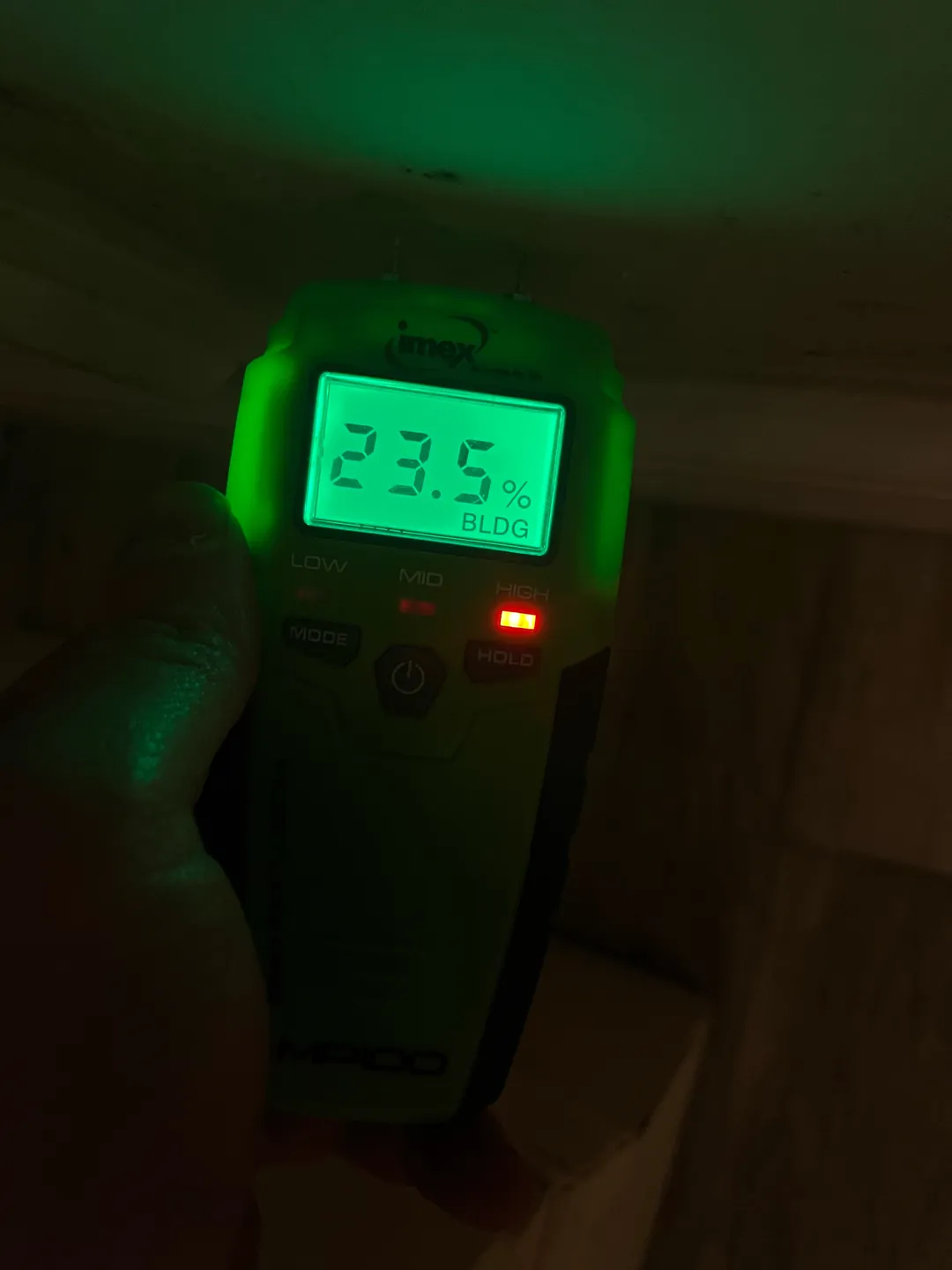
    We take meter readings where they’re useful, so we’re not guessing from a stain alone. On one of our jobs the meter was at 23.5% and marked high before we started.

  4. An honest recommendation

    We’ll explain what we think is going on, and why. If we can’t be sure yet, we’ll say so rather than push a treatment.

  5. A written report and a free quote

    You’ll get our recommendations in writing, and a no-obligation quote for the work. Full system spec sheets are available on request.

A damp meter reading 23.5% before treatment, marked high.
From one of our jobs: a damp meter reading of 23.5%, marked high, before treatment.

Not sure what you’re looking at?

Send a few photos for a free, honest first view, or book a free damp survey. No pressure either way.

Systems we can use

The right system for the wall, not a one-size job

We’ll recommend the right approach after the survey. These are the methods we use or advise on, where they genuinely fit.

Chemical DPC injection (cream)

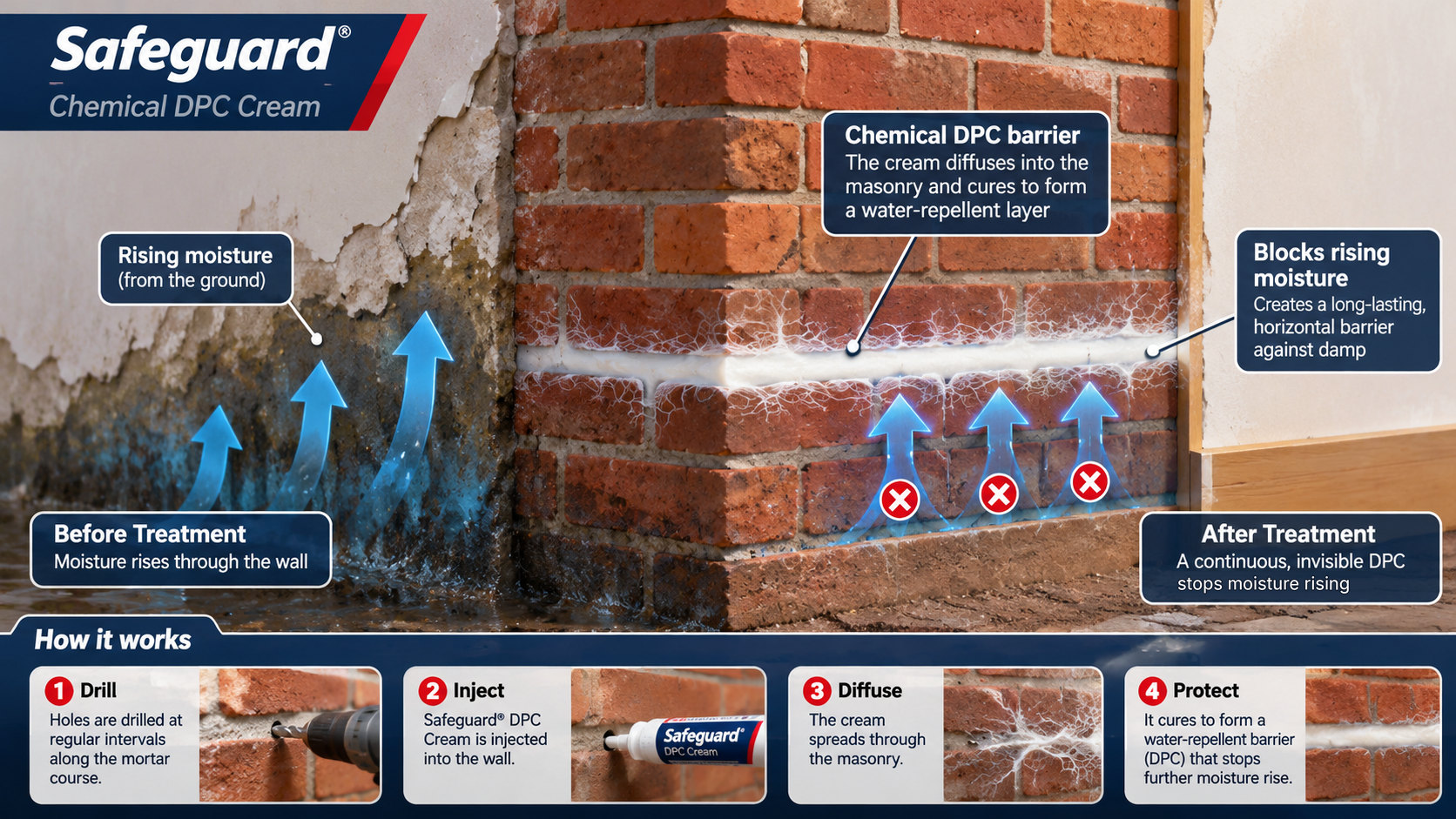
Where rising damp is confirmed and a new damp-proof course is appropriate, we inject a DPC cream into the mortar bed. It forms a barrier in the wall so moisture can’t keep rising. This is the method you can see in our job photographs.

Salt-resistant and renovating plasters

Plaster that has sat on a damp wall can be full of salts, and those salts keep drawing moisture back in. We take the failed plaster off, then finish with a renovating or salt-resistant system and a skim, ready to decorate once it’s dry. If we find decayed skirtings or floor timbers during the work, we can replace those too.

Tanking and cavity-drain membranes

Where a wall holds back earth, or sits below ground level, a waterproof tanking coat or a cavity-drain membrane can be a better approach than a DPC cream. We’ll only recommend either where the survey says it’s right, and we’ll be clear about what’s involved.

Breathable lime, for older solid walls

Older solid-wall houses often need to breathe. A dense modern plaster can trap moisture and make things worse. We use lime-based systems, including Kilsaran Lime Pro, where they suit the wall. We have completed this kind of work in North Killingholme, near Immingham.

External fixes

A lot of “damp” starts outside: cracked or hollow render, failed pointing, blocked gutters, high ground levels, or a path that has bridged the DPC. We can repair or renew the render — including a water-repellent silicone finish — point the masonry, and lower or pull back paths, steps and flower beds so the DPC can do its job.

Condensation and ventilation advice

If the problem is moist air on a cold surface, a DPC will not help. We’ll explain what’s causing it and advise on heating and ventilation. We don’t fit extractor fans, PIV units or other electrical work, but we can recommend an electrician if that’s what’s needed. We can carry out a mould wash, and we can replaster where the finish has failed.

How chemical DPC cream injection stops rising damp: drill, inject, diffuse, protect.
How chemical DPC cream injection works — drill, inject, diffuse, protect. Infographic by Safeguard. Tap the image to view it full size.
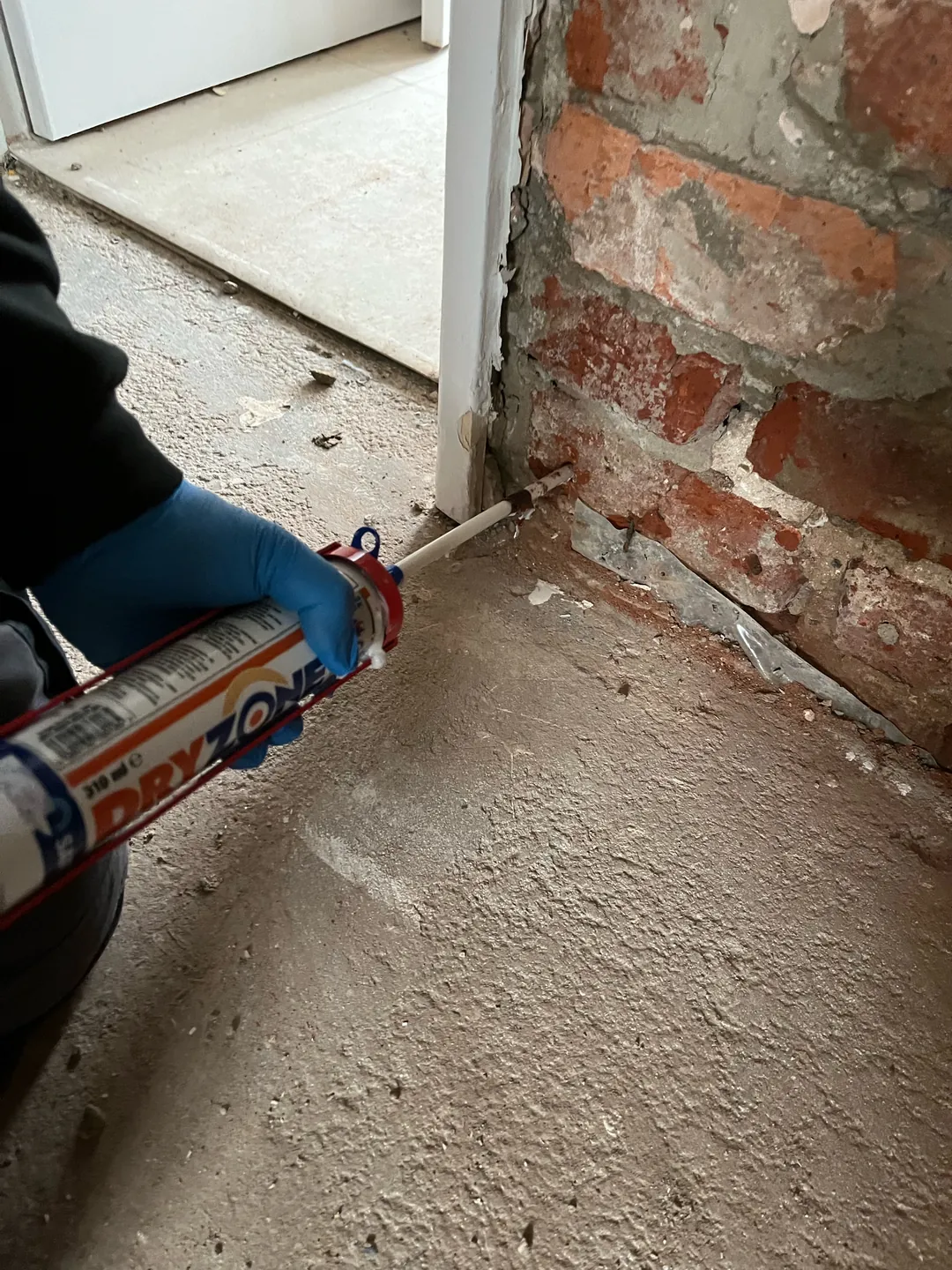
A damp-proof course cream being injected into the mortar of a brick wall.
From one of our jobs: a damp-proof course cream being injected into the mortar.

When to use which

A simple comparison, after the survey

This is a guide, not a diagnosis. We’ll confirm what’s right for your wall before any work starts.

What you might be seeing Often points to Typical approach, after the survey
Tide mark, salts and blown plaster on a ground-floor wall, up to about a metre Often rising damp, or a bridged DPC Survey and moisture readings first. If a new DPC is right, we inject a cream and replaster with a salt-resistant or renovating system.
A wet patch at any height, under a gutter, around a window, or behind cracked render Often penetrating damp from a building defect Find and fix the way in — gutters, pointing, render, seals — then repair or replaster the inside once the wall can dry.
Black mould on cold corners, around windows, behind furniture or on a bedroom ceiling Often condensation, not a failed DPC We won’t inject a DPC for this. We’ll explain the cause and advise on heating and ventilation. We don’t fit extractor fans or other electrical work, but we can recommend an electrician. We can carry out a mould wash, and we’ll only treat the wall if the finish itself has failed.
Damp just above a raised path, flower bed or external step Often a bridged DPC, or lateral damp from high ground Lower or pull back the ground where it can be done, check the DPC, and only inject or replaster if the survey says it’s still needed.
An older solid-wall house with dense cement render outside or gypsum plaster inside The wall may not be able to dry out A breathable lime system inside, and a vapour-open render outside, are often the better fit. We’ll say so honestly after we’ve looked.
A wall that holds back earth, or a below-ground wall that stays wet May need tanking, or a cavity-drain membrane We’ll recommend tanking or a cavity-drain membrane only where the survey says it’s the right approach, and we’ll be clear about what’s involved.

Start to finish

From your first message to a finished wall

Six clear steps. How long each takes depends on the wall and the time of year, and we’ll tell you before we start.

  1. Send photos or call

    WhatsApp a few pictures of the wall, inside and out, or give us a ring. We’ll give you an honest first view if we can.

  2. Free damp survey

    We visit, look at both faces of the wall, the ground levels, gutters, render and ventilation, and take moisture readings where they’re useful.

  3. Written recommendation and quote

    What we think is happening, why, and the work that fits — with a free, no-obligation quote. Spec sheets on request.

  4. Treat the cause

    We protect the room, take failed plaster back to a sound background and carry out the agreed treatment, inside or outside.

  5. Replaster properly

    A salt-resistant, renovating or lime-based system goes on, then a finishing coat, leaving the wall ready to dry.

  6. Aftercare and guarantee

    You get your Job Completion & Aftercare Pack: progress photos, drying-out and decorating advice, and your 10-year guarantee on damp proofing works in writing.

From one of our jobs

The treatment, step by step

From the meter reading to a finished plaster. On a rising-damp job the sequence typically looks like this; we’ll adapt it if the survey points to a different system.

  1. A damp meter reading 23.5% before treatment, marked high.
    1. SurveyMoisture readings, and a look at the wall, before anything comes off.
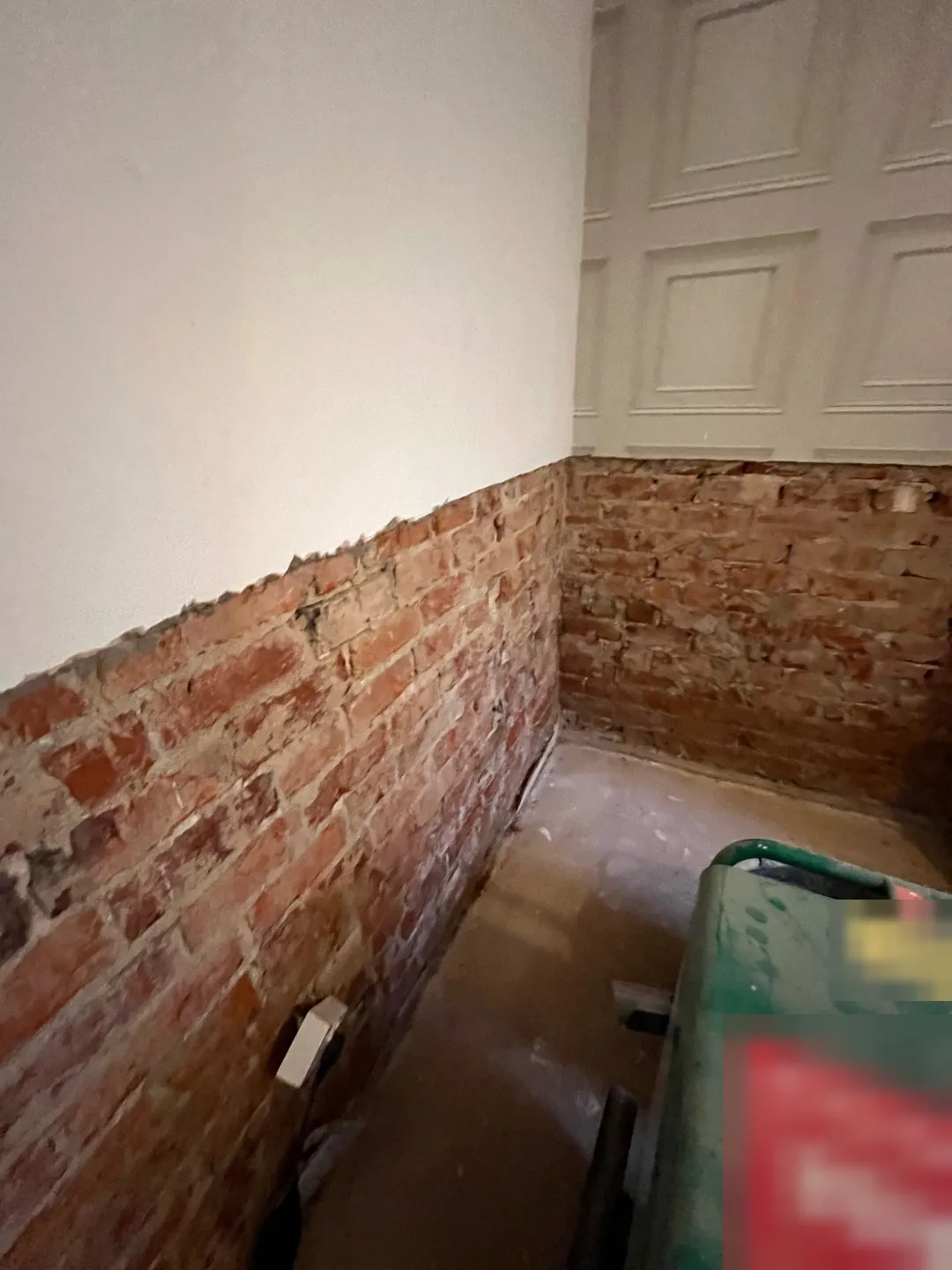
  2. Plaster taken off a damp-affected wall, back to the brick, at the start of a replastering job.
    2. Hack offFailed, salt-contaminated plaster comes off, back to a sound background.
  3. A damp-proof course being injected into the mortar of a brick wall.
    3. Damp-proof courseWhere it’s agreed, a DPC cream is injected into the mortar.
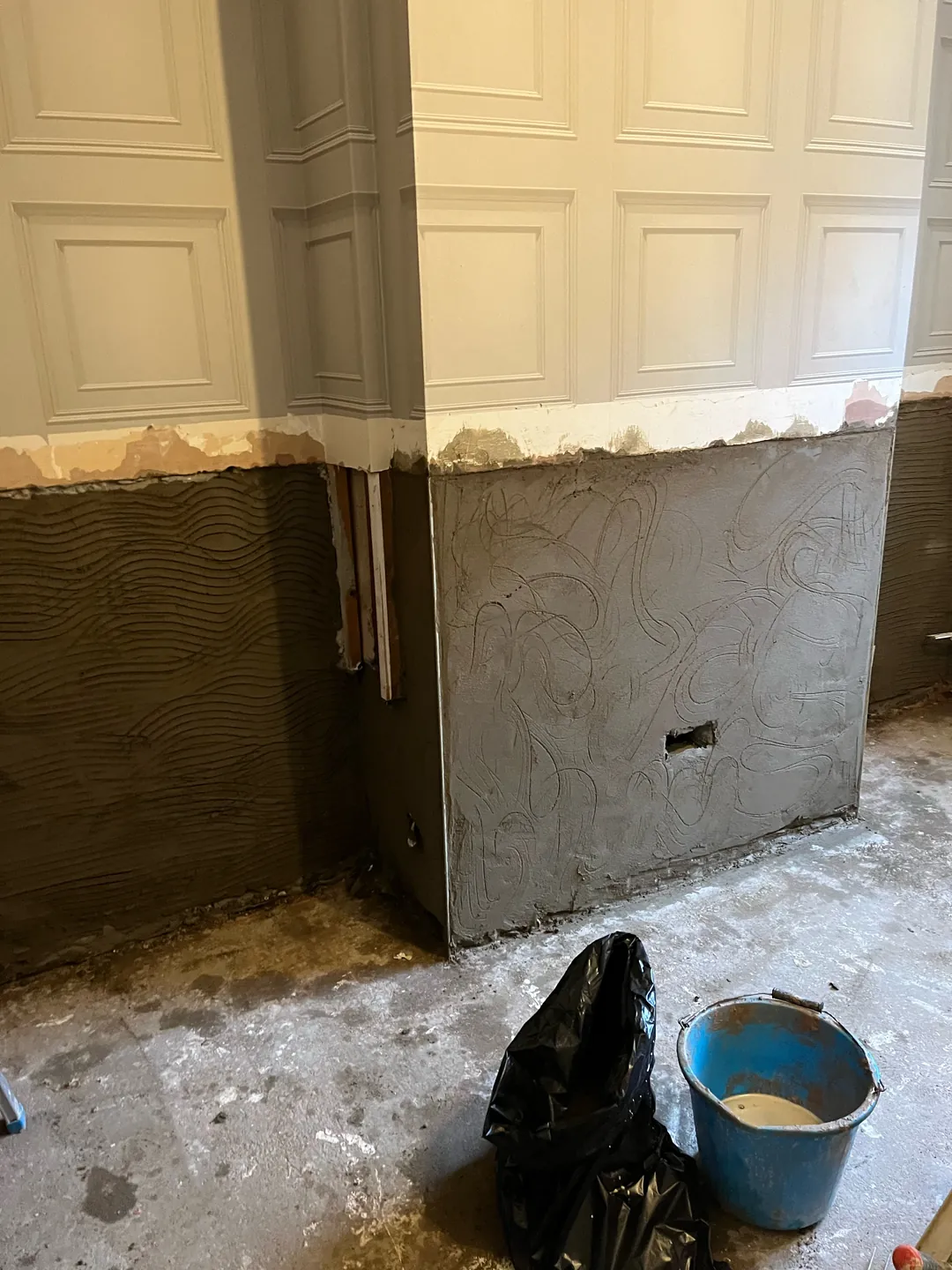
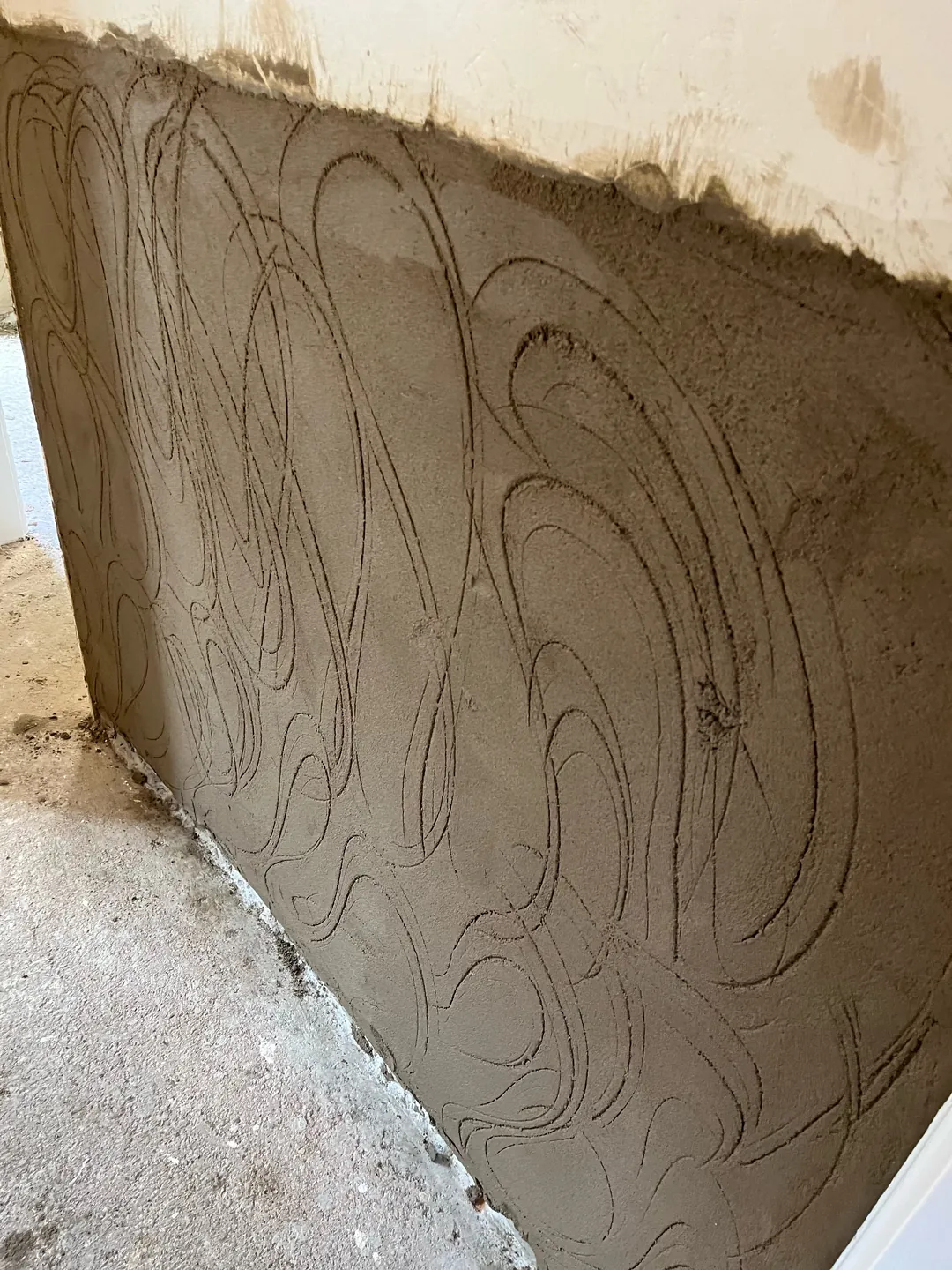
  4. Renovation scratch coat applied to the lower walls, with a scratched key for the finishing plaster.
    4. Scratch coatA renovating scratch coat, keyed for the finishing plaster.

Then the finish, and aftercare

A finishing skim goes on, and the room is left tidy, with advice on drying and decorating. We don’t ask you to paint too soon — the new plaster needs to dry properly first.

If the survey pointed to lime, an external repair, or tanking instead of a cream injection, the middle steps change, but the idea is the same: treat the cause, then finish the wall properly.

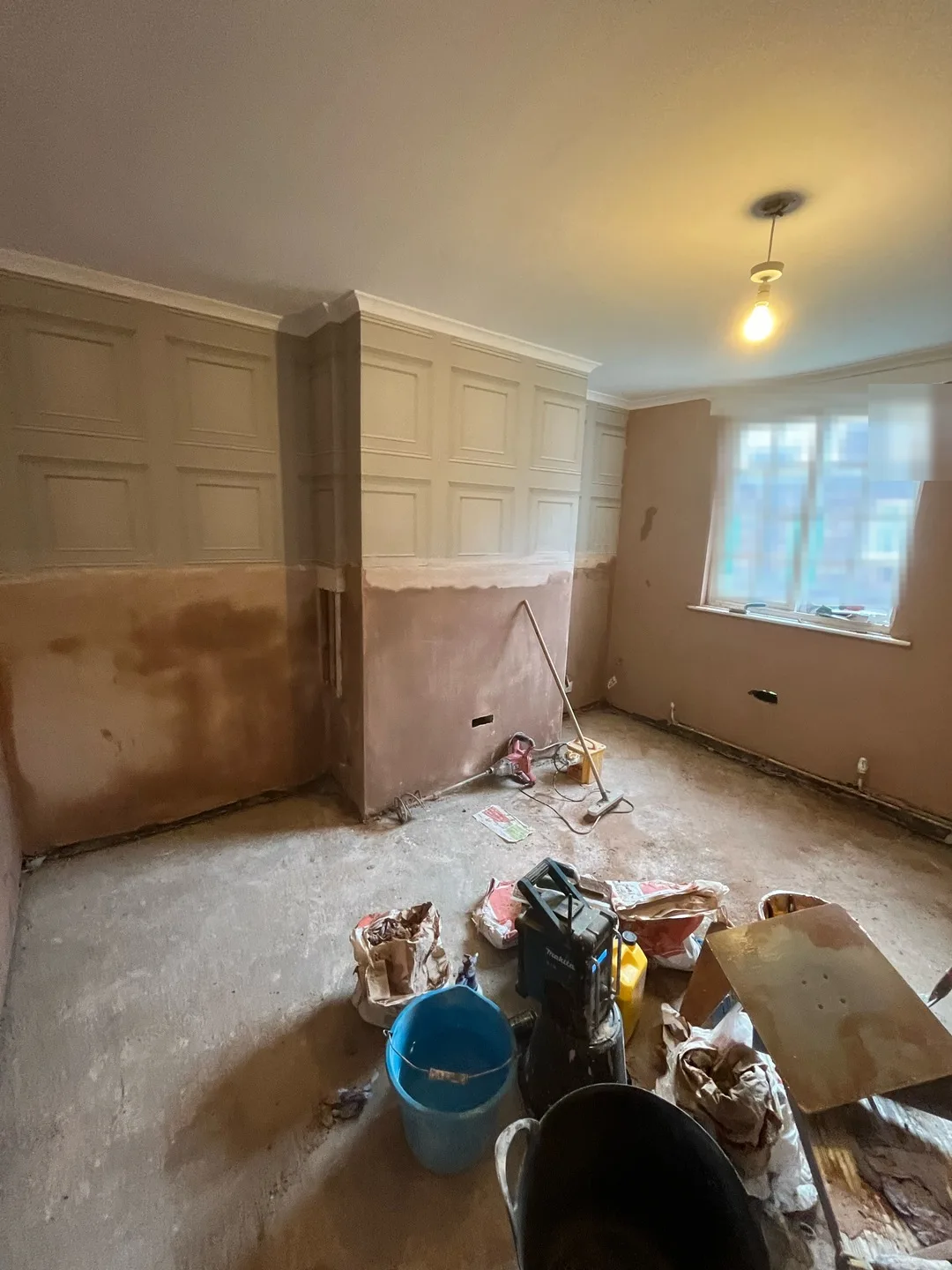
Replastering after damp treatment
The same kind of job, finished and ready to dry and decorate.

Damp and render

The outside of the wall often explains the inside

Failed, cracked or hollow render, tired pointing and high ground levels can let rain in, or hold moisture against the masonry. That’s penetrating damp, or a bridged DPC — and it’s a big part of why a render company also looks after damp.

A new breathable or water-repellent silicone render, a repair to the existing finish, or simply pulling soil and paving back below the DPC can be the thing that actually puts the wall right. We’ll look at both faces of the wall and quote for what’s needed, not just the room you first noticed.

Silicone render  ·  Render repairs  ·  Lime render  ·  Pebbledash removal

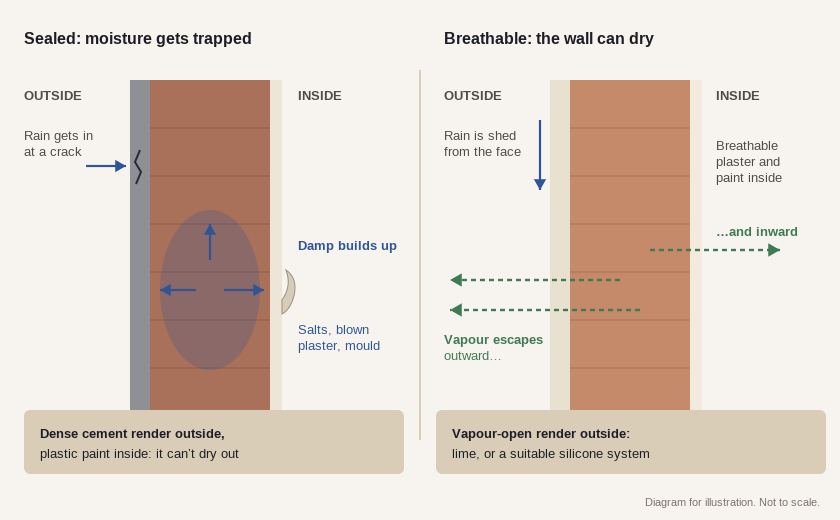
Two cross-sections of an old solid brick wall. With dense cement render and plastic paint, moisture is trapped and shows inside as salts and blown plaster. With a vapour-open render and breathable plaster, rain is shed and moisture can dry out both ways.
Why an older solid wall needs to breathe. Diagram for illustration. Read the guide →
Close-up of a renovation scratch coat, keyed for the finishing plaster.
A renovating scratch coat, keyed for the finishing plaster.

Guarantee

Guaranteed workmanship, and a 10-year guarantee on damp proofing works

Every damp-proofing job comes with guaranteed workmanship and a 10-year guarantee on damp proofing works, set out in writing. Your quote explains exactly what it covers. When we finish you get our Job Completion & Aftercare Pack: progress photos of the work, drying-out and decorating advice, and the guarantee in writing.

We’re a local team with 30+ years’ combined experience, fully insured, and there’s no obligation if you only wanted the survey and a price.

A 10-year guarantee on damp proofing

Every job comes with a 10-year guarantee on the completed work, and your written quote sets out exactly what it covers.

Not sure what the wall needs? We’ll check it for free

Ask for the full spec sheet for any system we quote. Before we recommend anything, we’ll carry out a free technical analysis of your walls: what they’re built from, the condition of the existing finish and any damp, so you can see exactly why we’re suggesting a system.

Damp proofing · our videos

On film

A short clip from one of our damp and replastering jobs, filmed on site.

Damp proofing and replastering A room stripped back, treated and replastered by the team. Watch on TikTok

See all our videos →

Reviews and recognition

Rated, guaranteed and insured

5-star rated on Google Read what our customers say on Google →
10yr 10-year guarantee On the completed work, whichever service you choose.
Fully insured 13+ years’ rendering experience, and fully insured on every job.
30+ years’ combined experience We use proven render systems from manufacturers including VPI, Licata, Kilsaran and Baumit.

FAQ

Damp proofing questions

Do you offer a free damp survey?

Yes. We look at the affected walls inside and, where it helps, outside, take moisture readings where they’re useful, and talk you through what we think is happening and why. You get our recommendations in writing and a free, no-obligation quote. If photos are enough to start with, WhatsApp those first.

Can you tell from photos whether it’s rising damp?

Photos on WhatsApp are a useful first step, and we can often give you an honest first view. Some walls need a visit and moisture readings before anyone can say what’s going on, and we’ll tell you if yours is one of them.

What’s the difference between rising damp and condensation?

Rising damp comes up from the ground, so it shows on ground-floor walls, usually as a tide mark, salts and blown plaster up to about a metre. Condensation is moist indoor air settling on a cold surface, so it shows as black mould on cold corners, around windows, behind furniture and on ceilings, on any floor. They need completely different fixes, which is why we look properly before recommending anything.

I’ve got damp upstairs. Can that be rising damp?

No. Rising damp stays low on ground-floor walls. Damp higher up is usually penetrating damp — a gutter, cracked render, pointing, a sill or a chimney letting water in — or condensation. We’ll look at the outside of the wall as well as the inside to find the way in.

Will you inject a damp-proof course even if it might not be rising damp?

No. A DPC will not fix condensation, a leaking gutter or a bridged DPC. If that’s what we find, we’ll say so and recommend the work that actually fits, even if it’s a smaller job or one you can sort yourself.

Why does damp seem worse in winter?

Walls are colder, windows stay shut, washing is dried indoors and the heating goes on and off. That’s the perfect setting for condensation, and wet weather also shows up any way rain is getting in. A wall that only looks bad in winter is a useful clue, so tell us when you first noticed it.

Do you only treat the wall, or do you replaster as well?

We quote for the full job where it’s needed: taking off the salt-damaged plaster, the treatment, and the new plaster finish, so you’re not left with a bare wall. Aftercare advice for drying and decorating comes with it.

What systems do you use?

It depends on the wall. That can include a chemical DPC cream injected into the mortar, salt-resistant or renovating plasters, breathable lime on older solid walls, tanking or a cavity-drain membrane where a wall holds back earth, lowering or pulling back ground that sits above the DPC, a mould wash where the surface needs treating, and replacing decayed skirtings or floor timbers. We also do outside work such as render repairs and pointing. We don’t fit extractor fans, PIV units or other electrical work — we’ll advise on ventilation and can recommend an electrician. We recommend the approach after the survey, not before.

Can render cause damp, and will new render fix it?

Cracked, hollow or very dense cement render can let rain in and stop the wall drying out, which shows up as damp inside. Repairing the render, or replacing it with a breathable system, can be what actually puts the wall right. It isn’t automatic, though, so we check both faces of the wall before suggesting it.

Do older solid-wall houses need lime?

Often, yes. Older solid walls were built to take on moisture and dry out again, and a dense modern plaster or cement render can trap it. Once we’ve looked at the wall, we’ll tell you honestly whether a lime-based system or another approach is the better fit.

Is it messy? What should I expect on the day?

Taking old plaster off is dusty and noisy, so we protect floors and furniture and keep the work area tidy as we go. We’ll talk you through what to move beforehand, which rooms are affected and roughly how the work will run, so there are no surprises.

How long before I can decorate?

The new plaster needs to dry properly before it takes paint, and drying time depends on the wall, the system and the time of year. We give you written aftercare advice with the job and won’t rush you into decorating too soon.

What guarantee do I get?

Guaranteed workmanship, and a 10-year guarantee on damp proofing works, set out in writing. Your quote explains exactly what it covers, and you get a Job Completion & Aftercare Pack with progress photos and drying-out advice when we finish.

Do you fit extractor fans or PIV units?

No. We don’t fit extractor fans, PIV units or any other electrical work. We’ll advise on ventilation and condensation, and we can recommend an electrician if that’s what’s needed.

Do you treat mould, replace skirtings, or install cavity-drain membranes?

Yes, where the survey says they’re needed. We can carry out a mould wash, replace decayed skirtings and floor timbers found during the work, install cavity-drain membranes on below-ground or earth-retaining walls, and lower or pull back paths and flower beds that have bridged the damp-proof course.

How much does it cost?

Every wall is different, so we don’t publish prices. WhatsApp 07400 219011, or use the form, for a free survey and a free, no-obligation quote.

Which towns do you cover?

We work across North Lincolnshire, North East Lincolnshire, Lincoln and nearby towns, including Grimsby, Cleethorpes, Immingham, Louth, Scunthorpe, Brigg, Lincoln, Mablethorpe and the other towns on our areas page. We don’t cover Hull, Doncaster or Skegness.

Ready for a free damp survey? It’s free, and there’s no pressure.

Call 07400 219011 Message us on WhatsApp