
Advice
Rising damp vs condensation: how to tell the difference
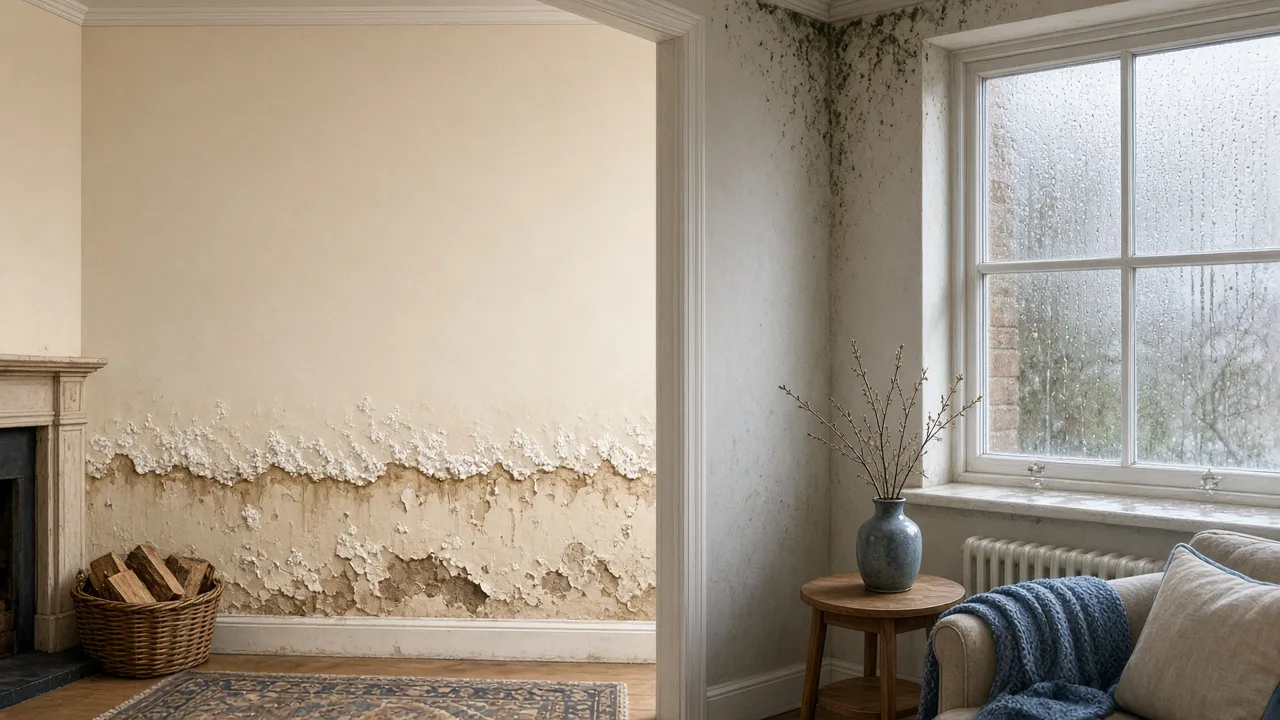
“Is it rising damp, or is it condensation?” It’s the question we’re asked more than any other about damp, and it matters, because the two need completely different fixes. Get it wrong and you can spend good money on a treatment that was never going to work, while the real cause carries on.
The good news is that, most of the time, the wall gives you strong clues. This guide walks through them in plain English: where the marks are, when they show up, what they look like, and a simple test you can do yourself. It won’t replace a proper look at the wall, but it will help you ask the right questions, and spot anyone who skips them.
The short version
- Rising damp comes up from the ground. It stays low on ground-floor walls, usually leaves a tide mark, and brings salts with it.
- Condensation comes out of the air. It appears wherever warm, moist air meets a cold surface, on any floor, and usually shows as black mould and wet glass.
Everything below is about how to tell which one you’re looking at.
Clue 1: where is it?
Location is the biggest giveaway.
Rising damp only affects walls in contact with the ground, so it’s a ground-floor problem. The marks start at skirting level and rarely climb much higher than about a metre, because that’s roughly as far as ground water can be drawn up through brick and mortar before it evaporates. If you can see damp on an upstairs wall, on a ceiling or halfway up a chimney breast, it isn’t rising damp.
Condensation goes wherever the coldest surfaces are. Typical spots:
- window glass, frames and sills
- the top corners of outside walls, where the wall meets the ceiling
- ceilings near the eaves, especially in bedrooms
- behind wardrobes, beds and sofas pushed against outside walls
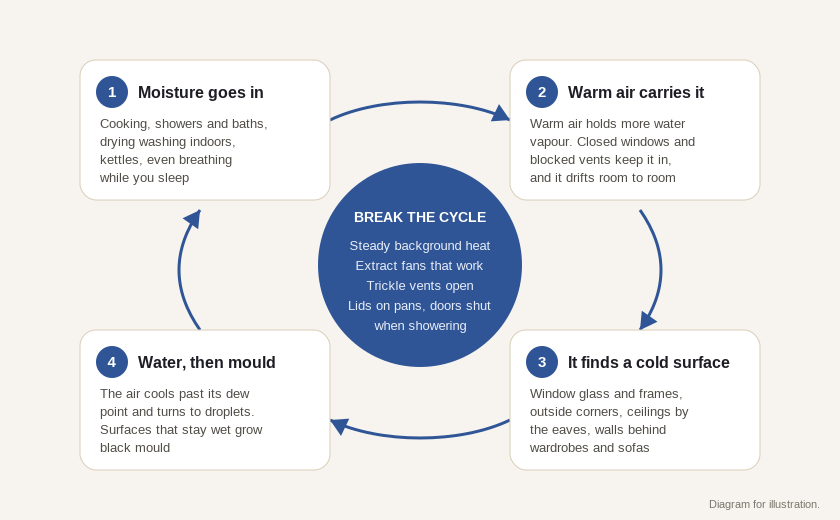
- bathrooms and kitchens, and rooms that stay shut
If the marks are high, in corners, or behind furniture, condensation should be your first suspect.
Clue 2: what does it look like?
Rising damp tends to leave:
- a brownish, uneven tide mark, roughly level along the wall
- white, fluffy salt crystals on the surface, or salts pushing paint and plaster off
- blown or crumbling plaster that sounds hollow when tapped
- skirting boards or timber at the base of the wall that are decaying
- a damp, musty feel low down
The salts are important. Ground water carries dissolved salts up into the wall. When the water evaporates, the salts are left behind in the plaster. Those salts then pull moisture out of the air, so the plaster can stay damp even on a dry day. That’s why simply painting over it never lasts.
Condensation tends to leave:
- black mould spots, often in clusters, in corners and around windows
- streaming windows first thing in the morning
- water collecting on sills and in the bottom of window frames
- walls that feel cold and slightly clammy, rather than wet to the touch
- usually no tide mark, and a dry lower wall
Clue 3: when does it happen?
Timing is a useful clue too.
Condensation is strongly seasonal. It’s at its worst from autumn to early spring, when walls are coldest, windows stay shut and more washing is dried indoors. It’s often worse first thing in the morning, after a night of people breathing in closed bedrooms. Many people find it eases off in summer.
Rising damp is much steadier through the year, although wet winters can make it more noticeable. If the marks hardly change from season to season, and they’re low on the wall, that points away from condensation.
We’ve written more about the seasonal side in why damp gets worse in winter.
A simple test you can do at home
If you’re not sure, try the foil test on a damp patch:
- Cut a square of kitchen foil, roughly 30 cm across.
- Tape it tightly to the wall on all four sides.
- Leave it for two or three days with the room used as normal.
- Peel it off and look at both sides.
If there’s moisture on the room side of the foil, the water is coming from the air, which points to condensation. If there’s moisture on the wall side, underneath the foil, the water is coming from inside the wall, which points to rising or penetrating damp.
It isn’t a diagnosis, but it’s a genuinely useful clue, and it costs nothing.
Why a meter reading alone can mislead
You might have had someone push a moisture meter against your wall, get a high reading and announce it’s rising damp. Be cautious.
Most handheld moisture meters work by measuring how easily electricity passes through the surface. They are designed for timber. On plaster, salts conduct electricity very well, so a salty wall can give a high reading even when it isn’t especially wet. Foil-backed wallpaper, some paints and metal behind the plaster can do the same.
That doesn’t make meters useless. We use one on every survey, and on one of our jobs the meter showed 23.5% and marked high before we started. But a reading is one piece of evidence, not the answer. The pattern of readings across and up the wall, and what you can see inside and outside, tell you far more than a single number.
It isn’t always one or the other
To be honest about it, plenty of homes have more than one thing going on. A ground-floor room might have a bridged damp-proof course and condensation in the corners. A cold, damp wall also attracts more condensation, because damp masonry is colder.
There’s also a third common cause that gets mixed up with both: penetrating damp, where rain gets in through a defect such as a leaking gutter, cracked render, failed pointing or a poor window seal. It can appear at any height, and it’s usually worse after rain. Our damp proofing page has a diagram of the most common ways in.
And sometimes a perfectly good damp-proof course has simply been bridged, by a raised flower bed, a new path or a patio laid too high against the wall. Lower or pull back the ground — work we can do — and the wall can dry out without any injection at all.
What to do next
If it looks like condensation, start with the everyday things: keep the heating at a steady low level rather than blasting it on and off, use extractor fans when cooking and showering (and leave them running for a while afterwards), keep trickle vents open, pull furniture a few centimetres away from outside walls, and avoid drying washing on radiators in closed rooms. Wipe down wet windows in the morning. If a fan needs fitting or replacing, we can advise and recommend an electrician — we don’t fit extractor fans, PIV units or other electrical work ourselves. We can carry out a mould wash, and we’ll look at the wall if the finish has failed.
If it looks like rising or penetrating damp, don’t just repaint. Find the cause first. That might be a new damp-proof course and a salt-resistant replaster, or it might be a gutter, some render or a flower bed. We’ll say which, honestly.
If you’re not sure, that’s normal. Send us a few photos of the wall, inside and out, on WhatsApp, or book a free damp survey. We cover Grimsby, Cleethorpes, Scunthorpe, Louth, Lincoln and the other towns on our areas page. We’ll never sell a damp-proof course for condensation, and every damp-proofing job we carry out comes with guaranteed workmanship and a 10-year guarantee on damp proofing works.