
Advice
Can render cause damp? Breathable vs non-breathable render explained
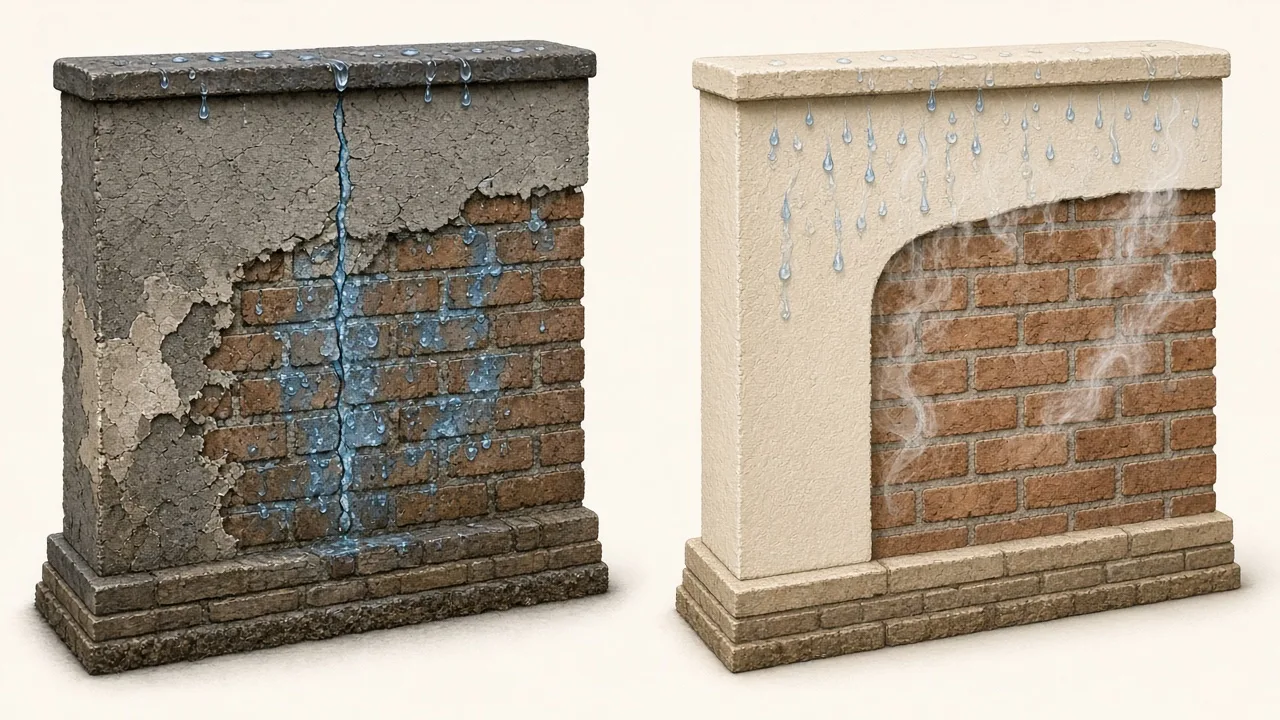
As a render company that also carries out damp proofing, we get asked this a lot: “Can render cause damp?” The honest answer is yes, it can. But render is also one of the best ways to protect a wall from damp. The difference comes down to the condition of the render, what it’s made of, and whether it suits the wall underneath.
This guide explains how the outside of a wall affects the inside, why some renders trap moisture, and what “breathable” really means.
How render is supposed to work
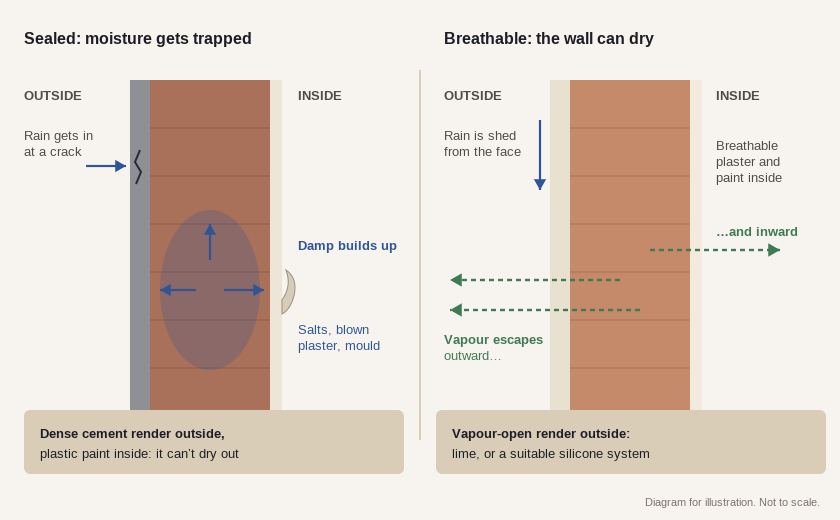
Render has two jobs. It sheds rain from the face of the wall, and it gives the house a clean, durable finish. A good render system keeps most of the weather out while letting any moisture that does get into the wall escape again as vapour.
That second part is the bit that often gets forgotten. Walls always take on some moisture, from wind-driven rain, from the ground, and from everyday life inside the house. A healthy wall is one that can dry out again faster than it gets wet.
Four ways render can lead to damp
1. Cracks let water in, and the render stops it getting out
Hairline cracks are common in old sand-and-cement render. Rain is driven into the crack by the wind, runs down behind the render and soaks into the brickwork. Because dense cement render is slow to let moisture back out, the water is trapped. Over time the wall behind gets wetter, and it shows up inside as damp patches, staining or blown plaster, often well above the height where rising damp could reach.
2. Hollow or blown render holds water against the wall
Tap an old render with your knuckle. If it sounds hollow, it has come away from the wall behind it. Water collects in the gap, frost can push the render off further, and the masonry behind stays wet. Hollow patches are one of the most common reasons we recommend taking an elevation back rather than patching it.
3. Hard, dense render on an older, softer wall
Older solid-wall houses, especially those built with soft bricks and lime mortar, were designed to take on moisture and dry out again through both faces of the wall. Cover that wall in a hard cement render, and often a plastic masonry paint on top, and you seal it in. The moisture still gets in through cracks, from the ground and from inside the house, but it can’t get out through the face. It looks for the easiest way out, which is usually inside, through your plaster.
The same thing happens indoors when old lime plaster is replaced with modern gypsum plaster and vinyl paint on a solid wall.
4. Render taken down over the damp-proof course
This is one we see often. If render has been taken right down to the ground, it can bridge the damp-proof course. Moisture from the ground climbs up the render instead, past the barrier, and into the wall above it. A properly detailed render stops above the damp-proof course line, usually finished with a bell-cast bead that throws water away from the base of the wall. Raised paths, patios and flower beds against the render cause the same problem.
What “breathable” actually means
“Breathable” is a word that gets used loosely. In render, it means vapour-open: water vapour can pass through the finish, so a damp wall can dry out. It does not mean the render lets rain in.
The best breathable systems combine two properties:
- Water-repellent, so rain beads and runs off the face instead of soaking in
- Vapour-permeable, so moisture already in the wall can escape
Two kinds of finish we use regularly do this well.
Lime render is the traditional choice for older solid walls. It is soft, flexible and highly vapour-open, and it works with the way an old wall was built to behave. We use lime-based systems, including Kilsaran Lime Pro, where they suit the wall. Inside, a breathable lime plaster does the same job, and we’ve used it on damp jobs such as a full replaster in North Killingholme. Our lime render page has more on when it fits.
Silicone render is a modern thin-coat finish that is strongly water-repellent but still lets the wall breathe. On the right background, applied as part of a full system over a suitable basecoat, it keeps the weather off while allowing vapour out. It’s our speciality: see our silicone render page.
What matters most is matching the system to the wall. A modern cavity-wall house and a Victorian solid-wall terrace don’t need the same thing, and that’s a conversation to have after someone has looked at the wall, not before.
Does that mean new render will fix my damp?
Sometimes, yes. If the damp inside is caused by cracked, hollow or unsuitable render, or by render bridging the damp-proof course, then putting the outside right is often the real fix. Taking off the old render or failed pebbledash, repairing the background, and finishing with a breathable system can let the wall dry out over the following months, and the inside can then be repaired properly.
But it isn’t automatic. If the damp is actually condensation, or rising damp from a failed damp-proof course, new render on its own won’t solve it. That’s why we look at both faces of the wall before recommending anything.
Signs the render may be part of the problem
- cracks in the render, especially ones that have widened or have staining around them
- areas that sound hollow when tapped
- render or pebbledash coming away in patches
- green growth or dark, wet-looking areas that stay wet after rain
- render that runs right down to the ground, or has soil or paving against it
- damp patches inside that line up with cracks or defects outside
- a solid-wall house with hard cement render and plastic masonry paint
What we do about it
On a free survey we look at the outside of the wall as well as the inside: the render, the pointing, the gutters, the sills and the ground levels. We take moisture readings where they’re useful and explain what we think is happening and why.
Then we recommend what fits. That might be a render repair, pebbledash removal and a new breathable system, lowering the ground away from the wall, a lime replaster inside, or a combination. It might also be damp treatment if rising damp is part of the picture. We’ll tell you honestly if it’s something smaller.
For more on the different kinds of damp, read rising damp vs condensation or what happens in a free damp survey.
We cover Grimsby, Cleethorpes, Scunthorpe, Louth, Lincoln and the other towns on our areas page. Send us a few photos on WhatsApp, or book a free survey. Render and damp proofing works both come with guaranteed workmanship and a 10-year guarantee, set out in writing.